United States
Flag

The
national flag of the United States of America often simply
referred to as the American flag, consists of thirteen equal
horizontal stripes of red (top and bottom) alternating with white, with a blue
rectangle in the canton (referred to specifically as the
"union") bearing fifty small, white, five-pointed stars arranged
in nine offset horizontal rows of six stars (top and bottom) alternating with
rows of five stars. The 50 stars on the flag represent the 50 states of
the United States of America and the 13 stripes represent the thirteen
British colonies that declared independence from the Kingdom of Great
Britain and became the first states
in
the Union. Nicknames for
the flag include the "Stars and Stripes"
Landmarks
in United States
Capitol Building

The Capitol Building is the home of the United States
Congress. The Congress consists of the Senate and the House of Representatives.
The Senate and the House of Representatives meet in the
Capitol Building to make laws that govern the country.
Mount Rushmore

Carved into
the granite wall of Mount Rushmore are the faces of 4 presidents: Washington,
Jefferson, Lincoln and Theodore Roosevelt. These presidents symbolize
the United States ideals: Washington standing for independence; Jefferson for
democracy; Lincoln for equality; and, Roosevelt for the role in world affairs.
Gutzon Borglum, a Danish sculptor, and a crew of over 360
people carved the monument from 1927 to 1941. The faces measure 60 feet from
chin to top of head, and would be 465 feet tall if the whole bodies were built
to this scale.
Statue of Liberty

The Statue of Liberty is one of the best known American
landmarks. It was a gift to the United States from France to commemorate their
alliance during the American Revolution. It is located in the New York harbor
near Ellis Island. The statue welcomed new immigrants to the United States who
entered the country through Ellis Island between 1892 and 1954.
The statue is 111 feet, 1 inch tall and made from 225 tons
of copper.
It was given to the people of the United States by France on
July 4, 1884 to commemorate the 100 anniversary of the American Revolution. It
was dedicated on October 28, 1886.
The white house
 The Whitehouse is the home of the United States president. It has been the home for every U.S. president, except George Washington.
Construction was started on October 13, 1792, on a site selected by George Washington. The house was not completed until 1800, when President John Adams moved in.
The original home was burned by the British in 1814, during the War of 1812. The house was rebuilt and painted white to cover its fire-blackened walls. This is how it got the name the Whitehouse.
Typical Food
Thanksgiving dinner

Today we eschew the venison they most certainly ate, and we cram their three days of feasting into one gluttonous gorge.
Indigestion notwithstanding, nothing tastes so good as that quintessential all-American meal of turkey (roasted or deep-fried bird, or tofurkey, or that weirdly popular Louisiana contribution turducken), dressing (old loaf bread or cornbread, onion and celery, sausage, fruit, chestnuts, oysters -- whatever your mom did, the sage was the thing), cranberry sauce, mashed and sweet potatoes, that funky green bean casserole with the French-fried onion rings on top, and pumpkin pie.
Cheeseburger
 Lunch counter, traditional, gourmet, sliders, Kobe. White Castle, Whataburger, Burger King, In-N-Out, McDonald’s, Steak N’ Shake, Five Guys, The Heart Attack Grill. It’s hard to believe, but it all began with a simple mistake.
Or so say the folks in Pasadena, California, who claims the classic cheeseburger was born there in the late 1920s when a young chef at The Rite Spot accidentally burned a burger and slapped on some cheese to cover his blunder.
Hot dogs
 Nothing complements a baseball game or summer cookout quite like a hot dog.
For that we owe a debt to a similar sausage from Frankfurt, Germany (hence, “frankfurter” and “frank”) and German immigrant Charles Feltman, who is often credited with inventing the hot dog by using buns to save on plates.
But it was Polish immigrant Nathan Handwerker’s hot dog stand on Coney Island that turned the hot dog into an icon. Every Fourth of July since 1916, the very same Nathan’s has put on the International Hot Dog Eating Contest (current five-time winner Joey Chestnut took the title in 2011, downing 62 hot dogs and buns in the 10-minute face-stuffing).
Apple pie
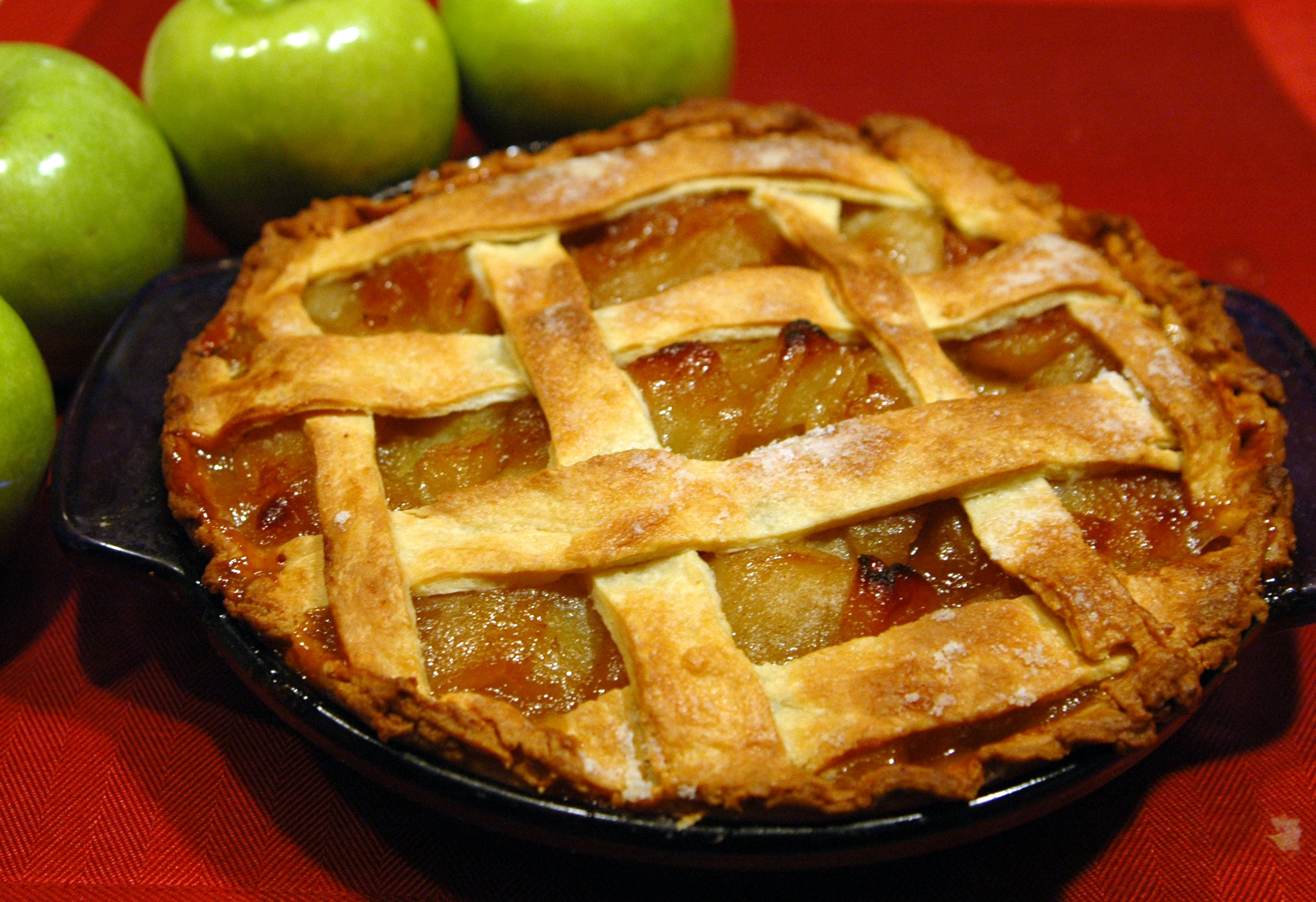 According to a pie chart (seriously) from the American Pie Council, apple really is our national favorite followed by pumpkin, chocolate, lemon meringue and cherry.
Not to burst the patriotic bubble, but it’s not an American food of indigenous origin.
Food critic John Mariani dates the appearance of apple pies in the United States to 1780, long after they were popular in England. Apples aren’t even native to the continent; the Pilgrims brought seeds.
So what’s the deal with the star-spangled association? The pie council’s John Lehndorff explains: “When you say that something is ‘as American as apple pie,’ what you're really saying is that the item came to this country from elsewhere and was transformed into a distinctly American experience.”
Education
In United
States, as in many countries, public education is divided into four basic
levels: primary, secondary and higher education.
The education in the United States is provided
mainly by the public sector, with control and funding from the three levels of
government, federal, state and local. Child education is compulsory.
Preschool
 Pre-kindergarten 3 (3-4)
Pre-kindergarten (4-5)
Elementary school
Kindergarten (5-6)
first grade- Fifth grade (6-11)
Middle school
Sixth grade- Eighth grade (11-14)
 High school
Freshman(14-15-16)
Sophomore (15-16)
Junior (16-17)
Senior (17-18)
Post-secondary education

No hay comentarios:
Publicar un comentario